What Did Charles August Fey Invent in San Francisco in 1895?
Charles August Fey is usually credited with inventing the three-reel slot machine in San Francisco in 1895. The claim needs a little care: gambling and amusement machines existed before Fey’s work, and the familiar machine called the Liberty Bell is often dated to a later stage of his development. His important contribution was to bring together rotating reels, a simple winning combination and an automatic mechanism that paid out prizes. That combination helped establish the form of the slot machine that would become familiar in casinos and other venues.
To understand the invention, it helps to look beyond the label “first slot machine”. Fey’s machine changed how a player acted, how a result was displayed and how a prize could be delivered. It also belongs to the particular history of San Francisco: a city of workshops, saloons and commercial entertainment in which small machines could turn a brief wager into a repeatable public pastime.
San Francisco before the three-reel machine
Slot machines did not appear from nowhere. In the late nineteenth century, coin-operated devices already offered customers a chance to test their luck. Some used playing cards, while others provided a small amusement or a trade incentive. The machines could take a coin and present a result, but they did not necessarily settle a win automatically. A proprietor might have to interpret the displayed result and pay the player, or the “prize” might be a drink, cigar or other item.
That distinction matters. A machine that displays a random-looking arrangement is not automatically equivalent to the later slot machine. In earlier card-based devices, the player’s task was to assess a poker hand shown on the machine. Fey’s design simplified the visual language: symbols appeared on reels, and particular alignments indicated a win. The mechanism and the display worked together to make the result easier to see and, importantly, easier to connect to a payout.
Charles August Fey, a German-born mechanic who settled in San Francisco, worked in the city’s growing world of mechanical entertainment. The usual account places his breakthrough in 1895. Historical summaries sometimes compress several stages of development into one date, however. It is safer to think of 1895 as the beginning of the design associated with Fey, with the best-known version, the Liberty Bell, emerging as his work developed in the following years.
What Fey’s machine did
The central innovation was a machine built around three rotating reels. A player inserted a coin and operated a handle. The reels spun, then stopped to show symbols in a row. If the symbols matched a winning pattern, the machine’s internal mechanism could release a payout. This linked three actions that earlier devices might not combine so neatly: paying to play, watching a mechanical display and receiving a result from the machine itself.
The best-known symbol set associated with Fey’s Liberty Bell included horseshoes, stars, playing-card suits and bells. Three Liberty Bell symbols aligned together formed the top combination. The name refers to the bell symbol, not to a general category of machines: “slot machine” is the broader type, while Liberty Bell is the name attached to Fey’s celebrated model.
Descriptions of the early machine commonly give its largest payout as 50 cents. That modest sum is useful context. The machine was not a modern casino game with electronic accounting, elaborate bonus rounds or a liberty bell slot machine large advertised jackpot. Its appeal lay in a compact, legible event: insert a coin, pull a handle, watch the reels stop and see whether a combination had appeared.
Feature What the player saw What the mechanism did Coin slot A clear place to begin a turn Accepted a coin and enabled the machine to operate Handle A direct, physical action by the player Started the reels and the machine’s operating sequence Three reels Symbols spinning and then stopping in view Presented a combination that could be judged against winning patterns Payout mechanism A visible or audible sign that a win had been registered Released a prize according to the machine’s internal arrangementWhy the three reels mattered
A three-reel format made the outcome easy to read. A player did not need to calculate a poker hand from several cards or ask an attendant to interpret an arrangement. The visible alignment of symbols supplied a compact rule: certain combinations counted as wins. This clarity was a design choice as much as an aesthetic one.
It also shaped the tempo of play. The handle gave the player a physical role in starting the action, while the reels delayed the answer for a few moments. That pause—movement followed by a stop—made chance visible as an event. Each turn was short, but the sequence could be repeated quickly. The machine therefore organised play through its own handling: coin, handle, spinning reels, result, next coin.
That pattern is one reason object-led history is useful. A machine’s material features tell us not only what it looked like, but what it invited people to do. A handle suggests a deliberate action; a coin slot sets a price for each turn; a payout opening connects the outcome to a reward. These are not decorative details. They are part of the game’s structure.
Visibility, handling and recording results
In Fey’s machine, the reels made the result visible at the point of play. The symbols were not merely illustrations of a result decided elsewhere; in the mechanical machine, their stopping positions were part of the physical process by which the result was presented. The machine’s design brought the player’s attention to the face of the device, where the outcome could be read.
That visibility should not be confused with complete knowledge of the mechanism. A player could see the reels stop without seeing the internal parts that governed them. The display revealed the result, but the machine’s workings remained enclosed. This separation—an open, readable face over a concealed mechanism—became a durable feature of gambling equipment.
Early machines also had practical challenges. They had to accept coins reliably, withstand repeated handling and distinguish an eligible play from an unauthorised attempt to operate the mechanism. A payout system had to deliver the promised prize and make the result credible to the player and proprietor. The machine’s design therefore addressed not just chance, but the everyday management of play: who could start a turn, how a result was identified and how a win was recorded in the most immediate sense, by the release of a payment.
There was no digital screen keeping a detailed account of wagers and outcomes. The transaction was embodied in the object: a coin went in, a mechanism operated, and coins or a prize could come out. That does not mean every early machine was identical, or that every payout arrangement worked in the same way. Surviving photographs and later replicas can show only part of a machine’s construction. A front view may reveal the reels and handle while leaving the coin path, internal gearing and payout assembly out of sight.
From physical reels to animated reels
Modern online gambling interfaces often use animated reels that imitate the movement of mechanical ones. Their familiar rhythm—symbols move, slow and stop—draws on a visual convention established by physical machines. But an animation is not evidence that a mechanical process is taking place. On a digital interface, the movement on screen is a designed presentation of an outcome, not a view into three physical reels turning inside a cabinet.
This distinction is useful when comparing historical objects with present-day games. A live stream showing physical equipment in use can help viewers observe handling: where a coin is placed, how a handle or button is operated, what parts are visible and how a payout is delivered. Even then, a stream shows only the equipment and camera angles included in the broadcast. It cannot necessarily disclose the internal mechanism, and it should not be treated as a substitute for examining the object itself.
Animated reels, by contrast, let us study the persistence of the visual convention. The three-part display, the stopping symbols and the line of alignment can survive on a screen even when the physical reels have disappeared. What we see may resemble a mechanical slot machine; what is happening under the interface is different. Keeping those two things separate prevents a common historical error: assuming that a familiar appearance proves a familiar mechanism.
Slot machines and the layout of other games
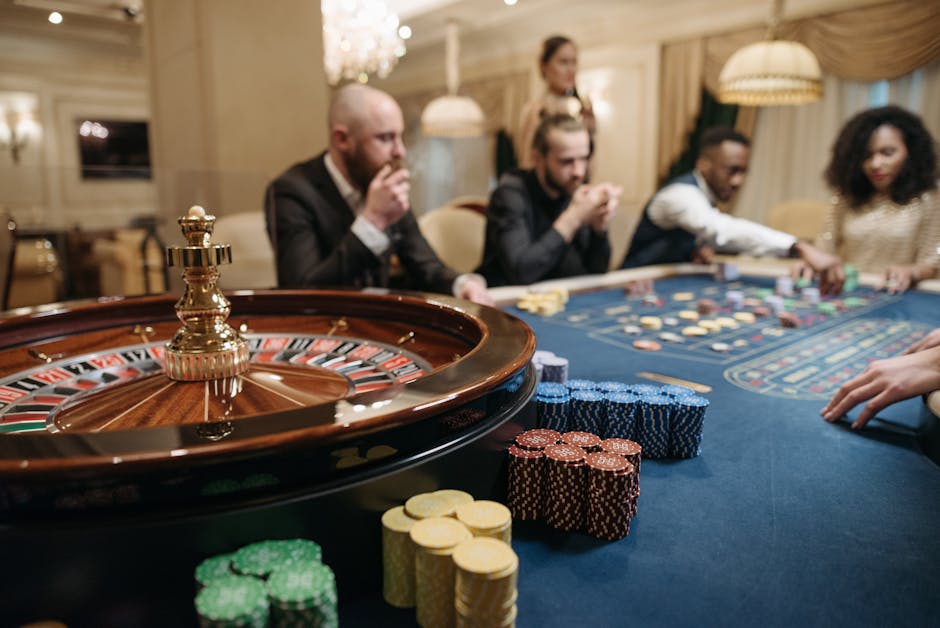
Fey’s machine was a self-contained cabinet, but casino equipment more broadly depends on how objects organise space and action. This is especially clear in table games. A roulette table, for example, is not simply a wheel. Its numbered wheel works alongside the betting layout, where marked areas indicate where players can place different kinds of wagers. The wheel produces the result; the layout structures the choices and makes those wagers visible to players and staff.
That distinction also helps clarify what a slot machine contributed. Unlike a roulette table, it did not need a shared betting surface covered in marked betting areas. Its coin slot, reel window and payout opening were incorporated into the cabinet. The object gathered the game’s essential actions into one footprint. A player did not need a dealer to announce a result or a group to agree which marked area held a bet. The machine’s face and mechanism provided a more self-contained sequence.
Different machines, however, should not be collapsed into one generic “casino machine”. A mechanical three-reel slot, a roulette wheel with a betting layout and a digital game displayed on a screen organise play in different ways. Their visual similarities can be instructive, but their equipment, handling and recording of results are not interchangeable.
What “invented in 1895” means
So, what did Charles August Fey invent in San Francisco in 1895? In the conventional account, he developed the first successful three-reel slot machine, a coin-operated device that presented symbol combinations and could pay out automatically. The Liberty Bell became the defining expression of that design. Earlier gambling and amusement machines existed, so Fey should not be described as inventing coin-operated chance from nothing. His achievement was to refine the form into a practical, repeatable machine whose action and result were both readily understood.
The date is best treated as a useful starting point rather than a claim that every feature appeared fully formed in a single moment. The history of the Liberty Bell is often told in a compressed way, and accounts may differ over the precise stages and dates. What remains clear is the significance of the design: three reels, recognisable symbols, a simple reading of winning combinations and a mechanism able to deliver a prize.
A small machine with a lasting design
The importance of Fey’s invention lies in the way its parts worked together. The cabinet controlled access to play. The handle made participation physical. The reels turned chance into a visible performance, and the payout mechanism connected the displayed result to a reward. Each feature shaped what a player could do and what an observer could understand.
That is why the object matters in the history of casinos and public entertainment. Fey’s machine did more than introduce a new set of symbols. It offered a compact arrangement of action, waiting and result—one that could be installed wherever a machine and its operator could attract players. Later digital games could preserve the three-reel image through animation, but the original design’s significance belongs to its physical equipment and the particular actions that equipment made possible.
In short, Charles August Fey’s San Francisco invention was not simply “the slot machine” in every form that followed. It was a practical mechanical model for a new kind of play: a coin-operated, three-reel game that made a result visible and could pay the player automatically. That is the foundation behind the enduring place of the three-reel slot machine in San Francisco slot machine history.